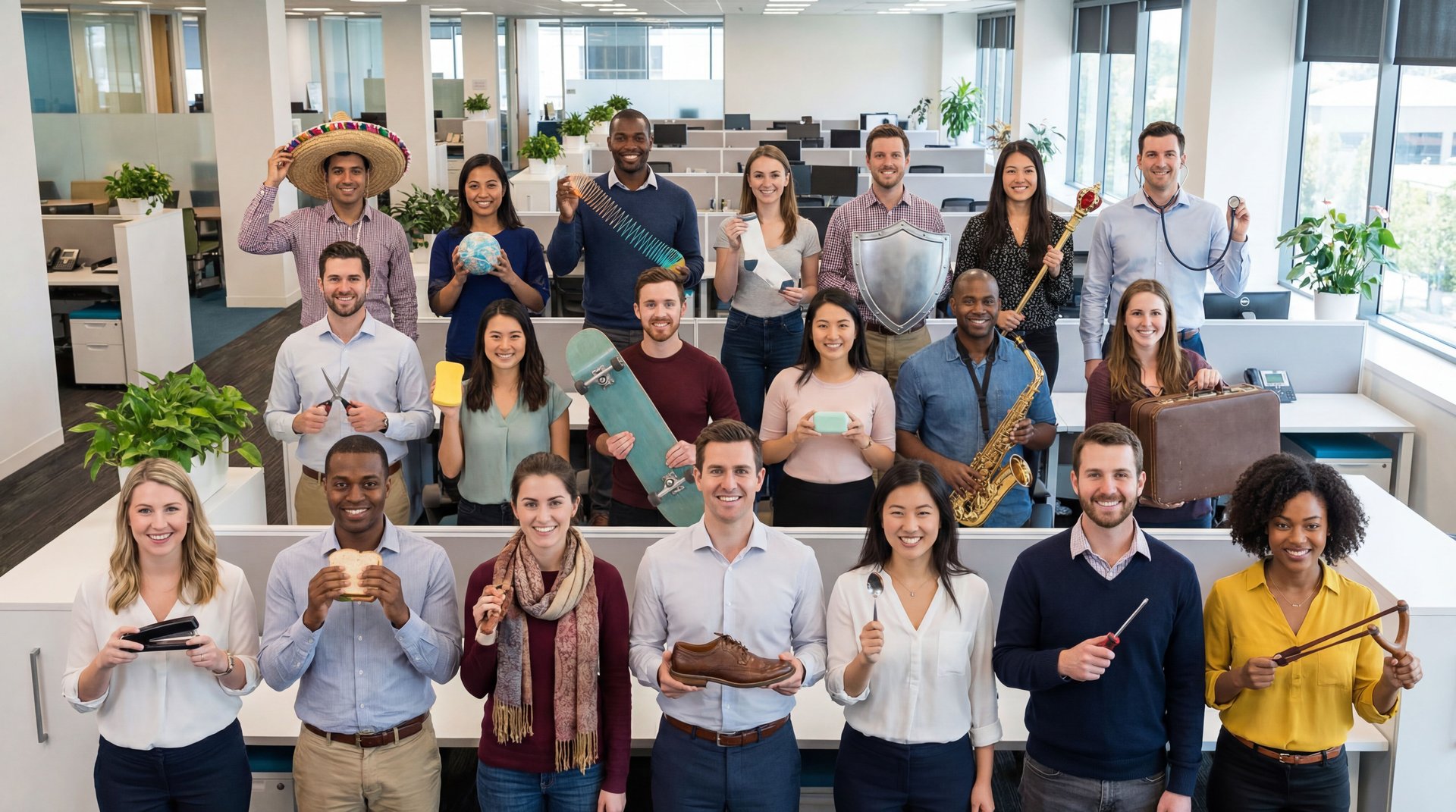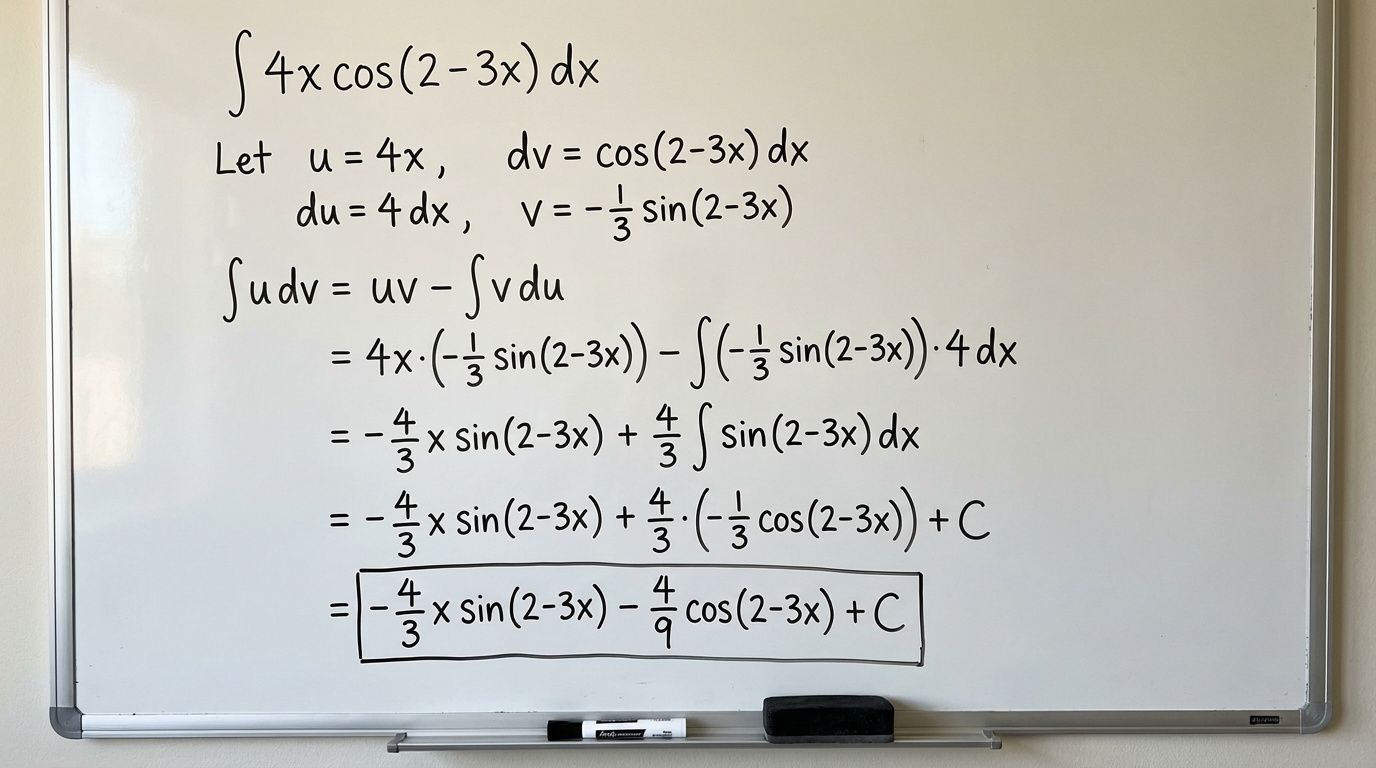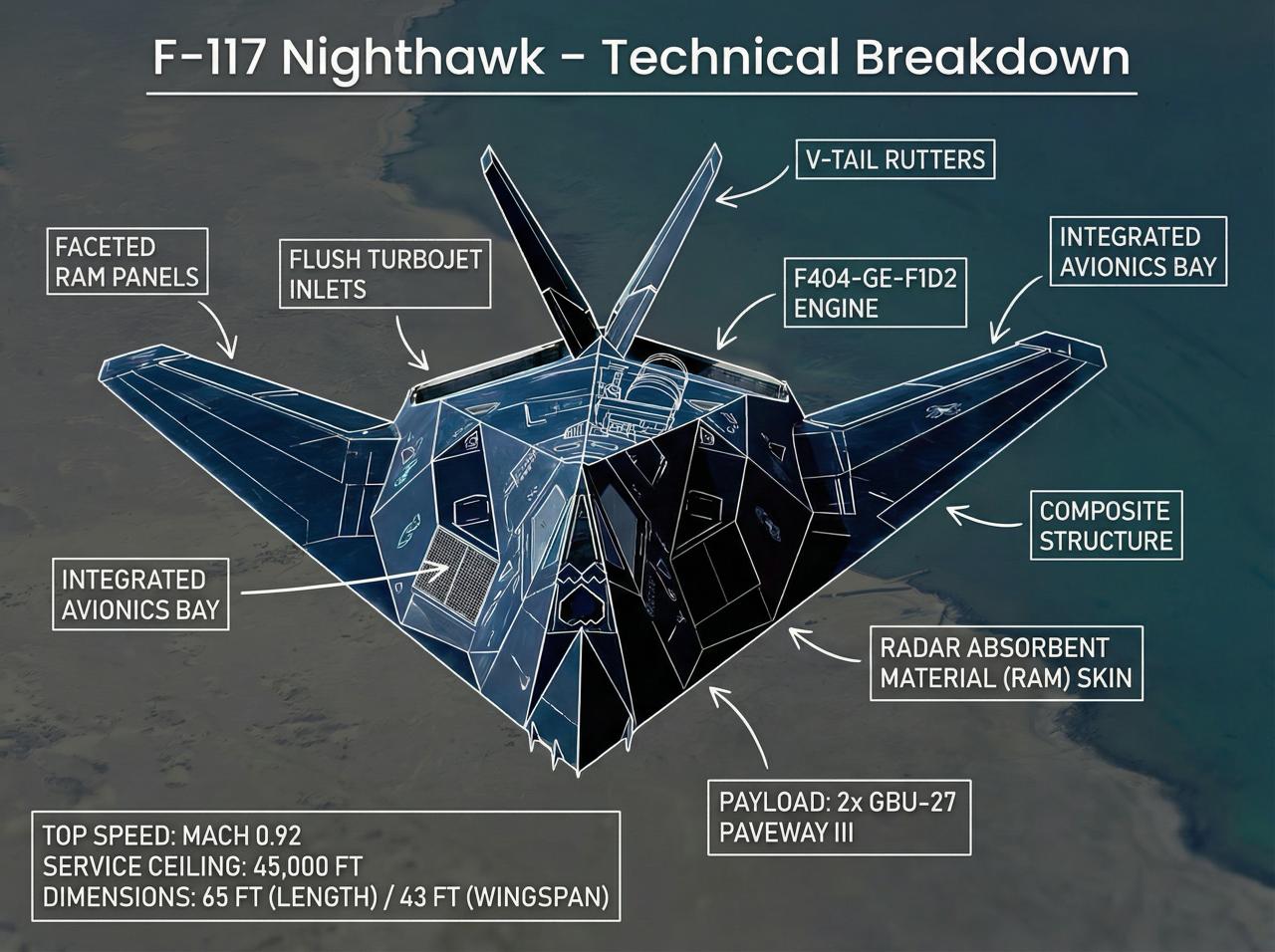
Nano Banana Pro represents a fundamental shift in diffusion technology. The model prioritizes comprehension and logical interpretation of the prompt. This unique reasoning engine ensures that Nano Banana Pro accurately respects complex structure, logic, and multi-step instructions, resulting in highly precise and reliable image generation.
And because of that, the prompts you write should reflect a new kind of strategy - one that leverages the model’s reasoning engine, its text-handling accuracy, and its ability to respect structure, logic, and multi-step instructions.
As the Head of Prompt Engineering at Higgsfield, I’ve spent the last weeks building the Nano Banana Pro Expert Prompts - a collection of high-precision templates designed to maximize the model's power and leverage what it can uniquely offer.
Below is the official Nano Banana Pro Expert Use Cases, very similar to the ones our creative engineers used internally.
1. LONG STRUCTURED PROMPTS - “Logical Layout Anchors”
Nano Banana Pro understands spatial constraints in a way previous models never did. These prompts turn your scene into a structured blueprint.
Why it works: The model now recognizes every part of the canvas as real semantic regions, not abstract suggestions. Use this when you need posters, covers, dashboards, infographics, presentations, or social ad layouts.
Use Case Spotlight:
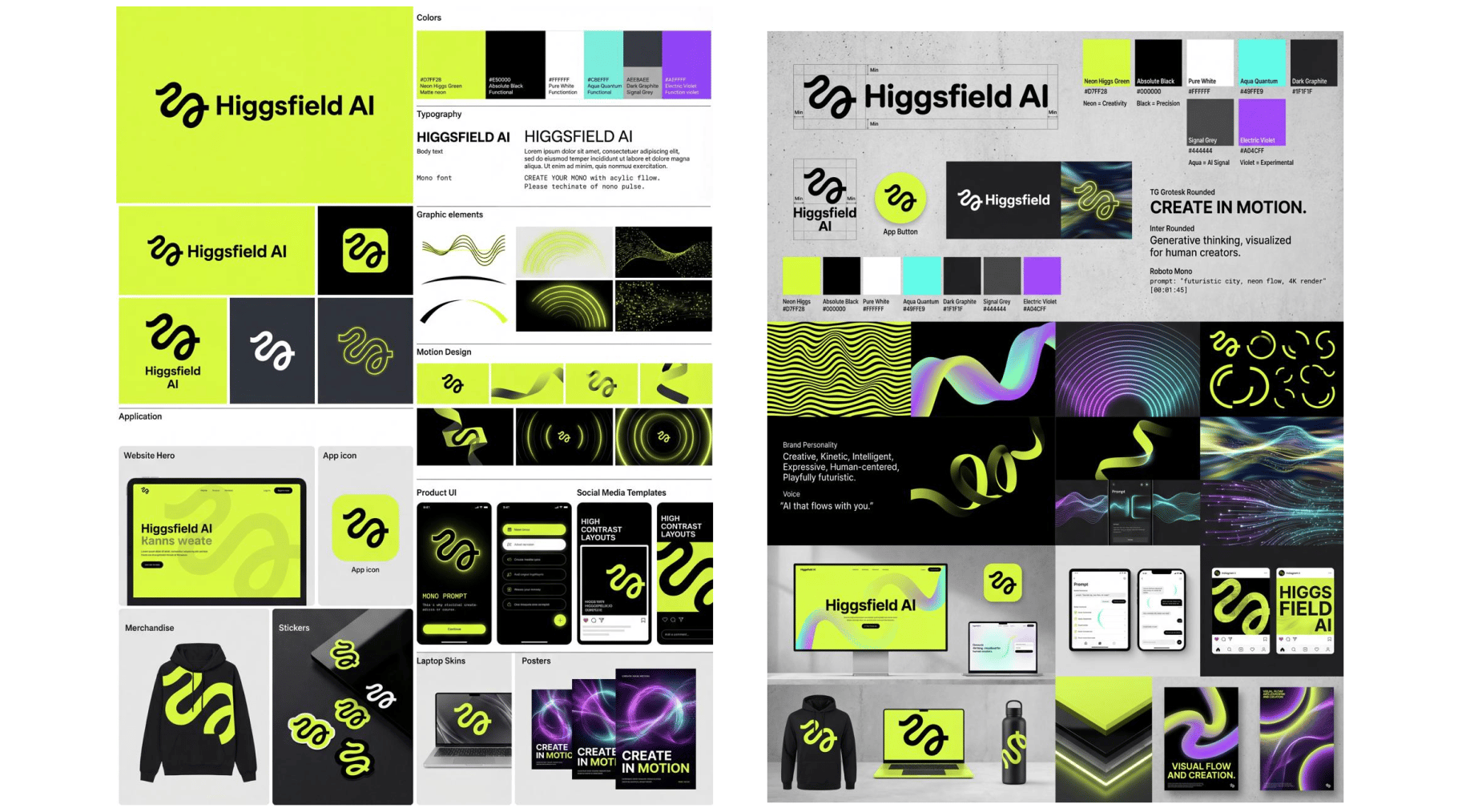
Prompt: "Prompt: "Create a full, multi-dimensional brand identity system for “Higgsfield AI,” an advanced AI platform for image, video, animation, and generative creativity. Base all visuals around the looping black S-curve logo on neon green (smooth, continuous thick curve). The identity must feel futuristic, high-tech, kinetic, expressive, human-friendly, and motion-driven.
LOGO SYSTEM: Use the black looping S-curve as the core symbol of generative flow and AI motion paths. Wordmark: “Higgsfield AI” in bold geometric rounded sans serif, open spacing. Variants: icon + wordmark, stacked, icon-only, white version, neon-outline version. Rules: never warp the curve, maintain high contrast, minimum padding = 50% logo height.
COLOR PALETTE: Core colors: Neon Higgs Green #D7FF28; Absolute Black #000000; Pure White #FFFFFF. Supporting: Aqua Quantum #49FFE9; Dark Graphite #1F1F1F; Signal Grey #444444; Electric Violet #A04CFF. Meaning: Neon=creativity, Black=precision, Aqua=AI signal, Violet=experimental mode.
TYPOGRAPHY: Headlines in rounded geometric sans (TG Grotesk / Satoshi / Inter Rounded); body text in modern grotesk; UI text in technical mono for prompts/code.
GRAPHIC LANGUAGE: All visuals derived from S-curve geometry: wave lines, curved dividers, latent-space fields, neon arcs, circular glyphs, repeating wave patterns, neon gradients, ribbon motion paths, particle flows.
BRAND PERSONALITY: Creative, kinetic, intelligent, expressive, human-centered, playfully futuristic. Voice: confident, imaginative, direct. Sample lines: “Create in motion,” “Generative thinking visualized,” “AI that flows with you.”
MOTION DESIGN: Logo animates as a fluid ribbon; particle formation; elastic curves. UI motion uses curved reveals, neon pulses, smooth transitions, camera-path sweeps. Add generative energy layers: particle trails, wave distortions, neon field glows.
APPLICATIONS: Website hero with neon green background and faint flowing S-curve; app icon with curve centered on neon field; product screens with clean UI, neon micro-highlights, mono font prompts, curved separators. Social templates: high contrast, oversized curve textures. Merch: hoodies, stickers, laptop skins, water bottles using the loop motif. Posters: cinematic neon fields and curved-path shapes.
MATERIALS & LIGHTING: Matte neon surfaces, subtle grain, polished black acrylic, soft neon edges, transparent stacked layers. Lighting with radial neon glow, soft volumetric gradients, highlights following curvature.
BRAND MYTHOLOGY: The S-curve symbolizes the Higgs Field - an abstract creative fabric where ideas form and transform. Represents movement, energy pathways, expressive AI, and continuous generative flow."
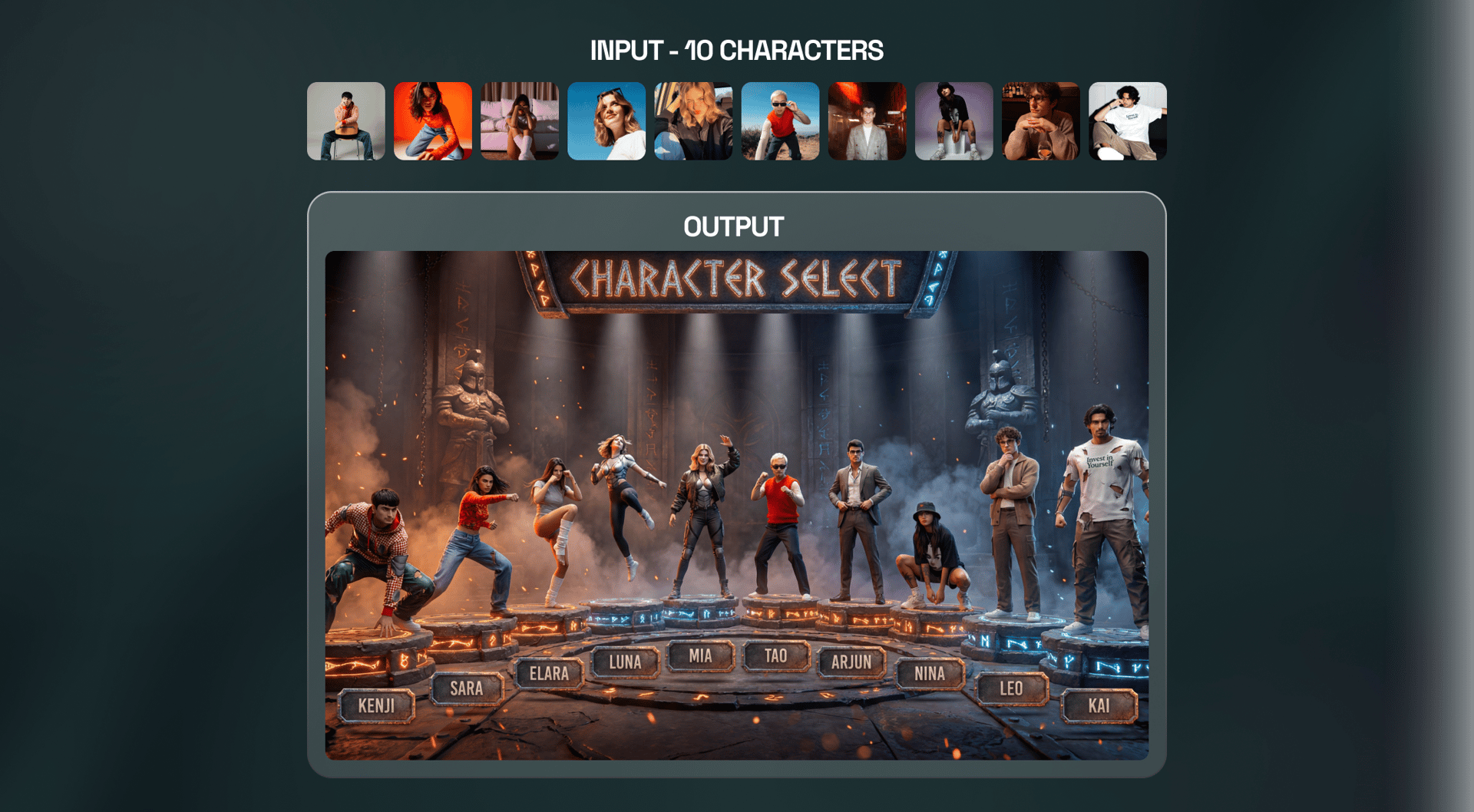
2. JSON prompts with multiple input images: The 3D Fighting Game Character Select Screen
This JSON-structured prompt is the apex demonstration of Nano Banana Pro’s ability to interpret and synthesize a vast array of simultaneous, interconnected instructions - spanning character pipelines, game design, UI/UX, and highly specific artistic direction.
The Breakdown (The "System Integration" Failure): Prior generative models would collapse under the sheer volume and interconnectedness of these constraints. They would struggle with:
Character Identity & Transformation: Maintaining the identity of 10 different characters from source images while simultaneously transforming them into 3D fighter models with unique action poses.
UI/Layout Overlay: Generating a complex, thematically consistent UI (title, empty name plates, runic motifs) over the characters, respecting the specified arc layout and spacing.
Unified Aesthetic: Ensuring the lighting (harsh spotlights, fiery side, cold back), environment (dark arena, glowing fissures), and color palette (molten orange, cold steel blue) are applied consistently across all elements without bleeding into or distorting character details or UI.
Hierarchical Interpretation: Understanding that character names should not be described, but their 3D fighter transformation should occur, with specific posing.
Nano Banana Pro's Logic Gate: This prompt activates a full suite of Nano Banana Pro's advanced engines:
Semantic Parsing of Structured Data: The model’s reasoning core is able to parse and execute instructions derived from a structured data format (like JSON), assigning parameters to specific image components.
Advanced Character Pipeline: Simultaneously manages 10 distinct character identities, applies 3D fighter styling, generates unique dynamic poses, and integrates them into a single scene.
Complex UI/UX Cohesion: Renders a sophisticated user interface with specific text, stylization, and logical placement that harmonizes with the gritty game aesthetic.
Environmental & Lighting Orchestration: Directs multiple light sources to create fog, embers, and dramatic shadows, all within a detailed, custom-built arena environment.
Multi-Constraint Synthesis: The most critical aspect is the model’s ability to perform all these tasks concurrently and coherently, ensuring that the character transformations, UI overlays, environmental details, and lighting all align with the overarching "dark, gritty, high-intensity 3D character selection screen" theme.
The Result: The successful generation of this prompt is a fully formed concept art piece, ready for a game development pipeline. It proves Nano Banana Pro's unprecedented capacity for systems-level image generation, where a complex set of interlinked instructions results in a complete, logically consistent visual product.
Prompt:
"{
"title": "3D Fighting Game Character Select Screen",
"description": "Generate a dark, gritty, high-intensity 3D character selection screen inspired by brutal, arena-style modern fighting games (without naming any titles).",
"characters": {
"source": "uploaded images",
"count": 10,
"rules": [
"Make up a name for each characer",
"Do not describe their physical appearance",
"Do not modify their identity",
"Transform each into a realistic 3D fighter model",
"Each fighter must have a unique, powerful, combat-ready action pose"
]
},
"visual_style": {
"render_type": "hyper-realistic AAA 3D graphics with a gritty cinematic finish",
"lighting": [
"harsh directional spotlights from above",
"fiery warm-orange side lights",
"cold shadowy blue backlights",
"thick atmospheric fog with volumetric beams",
"embers, dust, and floating particles"
],
"environment": {
"arena": "dark stone-and-metal arena platform with cracks, glowing fissures, and heavy atmosphere",
"floor": "rugged metallic floor with worn textures and faint reflections",
"background": "massive ceremonial statues, arcane symbols, chains, smoke plumes",
"platforms": "each character stands on their own circular engraved platform with glowing runes or energy lines"
},
"color_palette": [
"molten orange",
"blood-red accents (non-graphic)",
"cold steel blue",
"charcoal black",
"embers and fiery yellows"
],
"camera": {
"angle": "low-angle heroic shot",
"perspective": "wide cinematic lens emphasizing power and scale",
"effects": [
"subtle vignette",
"depth of field tuned for dramatic silhouettes",
"filmic contrast"
]
}
},
"ui_elements": {
"title_text": "CHARACTER SELECT",
"character_name_plates": "Rugged metallic plaques or glowing stone-like labels under each character, empty for later name entry.",
"interface_style": "ancient-meets-modern combat UI with glowing edges, heavy metal textures, runic motifs and high-contrast menu frames"
},
"layout": {
"arrangement": "10 characters displayed in a curved arc formation, each on their own platform",
"spacing": "wide spacing for clear silhouettes and dramatic pose readability",
"hierarchy": "central fighters slightly more forward, balanced left and right"
},
"tone_and_vibe": {
"keywords": [
"dark fantasy combat",
"ancient mystical energy",
"brutal atmosphere (non-graphic)",
"competitive intensity",
"epic warrior presence",
"arena showdown energy"
]
}
}"
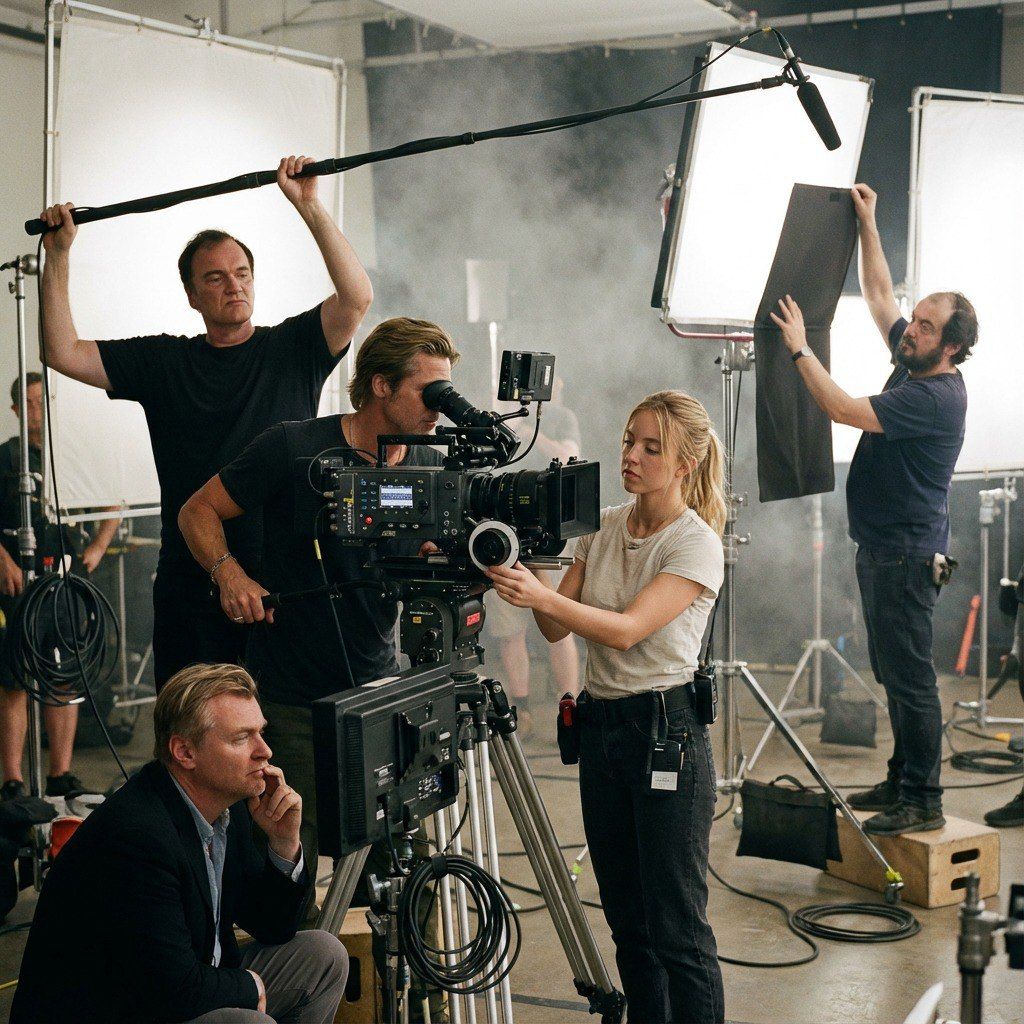
3. SCENE COMPOSITION & ATMOSPHERE in a Simple Prompt: The "Film Crew" Backstage
This prompt showcases Nano Banana Pro's sophisticated control over scene composition and the nuanced details even with simple prompts required to convincingly render a "behind-the-scenes" environment.
Prompt: "Behind-the-scenes wide shot showing a film crew setting up a cinematic portrait scene."
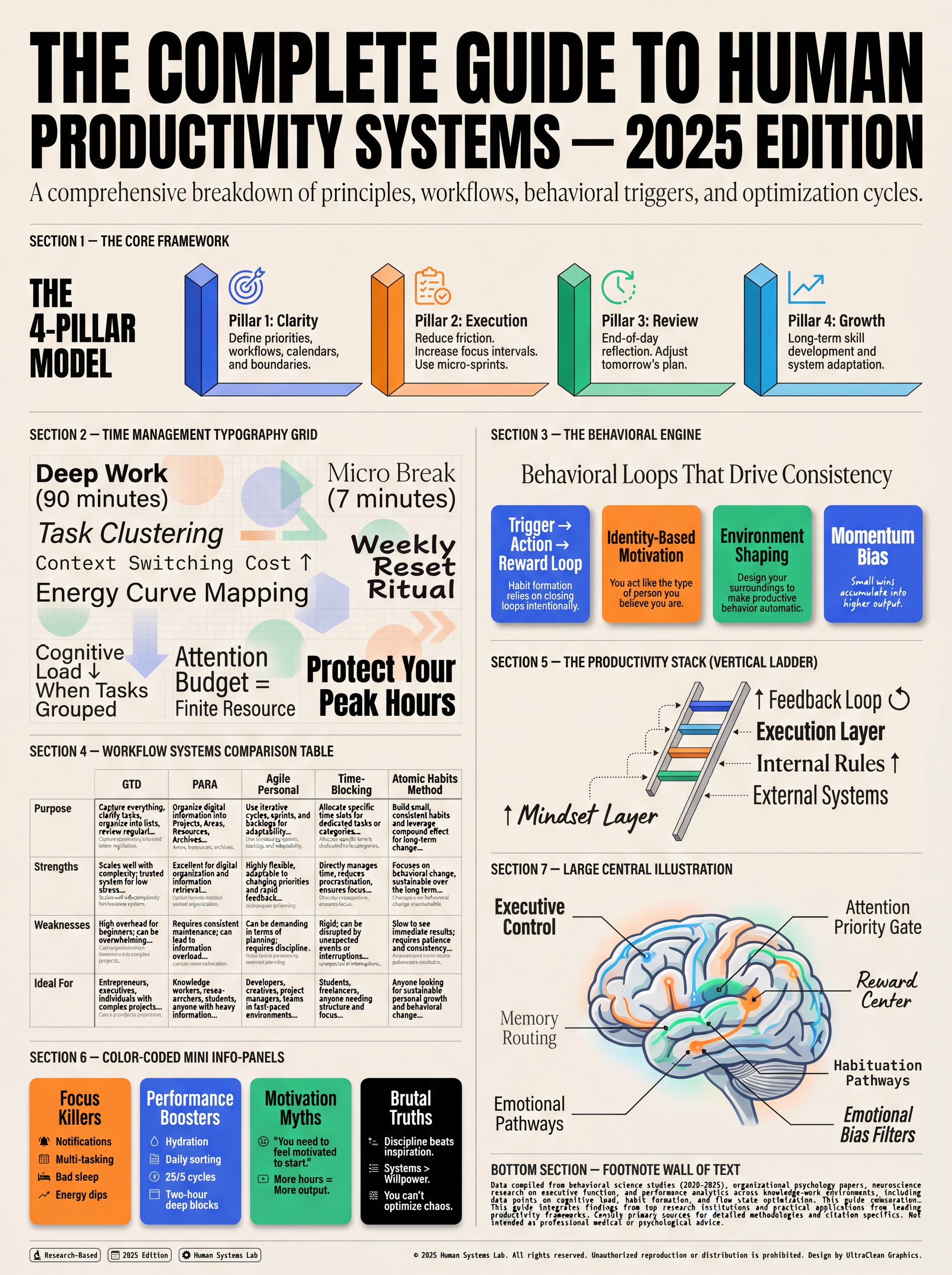
6.1. EXTREME INFOGRAPHICS: The “Complete Guide to Productivity” Poster
This prompt represents the apex of Nano Banana Pro’s structural and typographical control, demanding the creation of a full-scale, multi-section informational poster that uses a complex hybrid aesthetic and multiple font families to organize dense data.
Prompt: "Top header: Massive bold condensed title “THE COMPLETE GUIDE TO HUMAN PRODUCTIVITY SYSTEMS - 2025 EDITION” with a light serif subtitle describing it as a breakdown of principles, workflows, behavioral triggers, and optimization cycles.
Section 1 - The Core Framework: Include a left-column geometric-sans title “THE 4-PILLAR MODEL” and right-column pillars: Clarity (define priorities, workflows, boundaries), Execution (reduce friction, focus intervals, micro-sprints), Review (end-of-day reflection, adjust plan), Growth (skill development and system adaptation). Add minimalist line icons (target, checklist, clock, graph).
Section 2 - Time Management Typography Grid: A dense mixed-font mosaic featuring phrases like “Deep Work (90 minutes)” (ultra bold), “Micro Break (7 minutes)” (thin serif), “Task Clustering” (italic condensed), “Context Switching Cost ↑” (monospace), “Weekly Reset Ritual” (handwritten), “Energy Curve Mapping” (wide rounded), “Cognitive Load ↓ When Tasks Grouped” (serif small caps), “Attention Budget = Finite Resource” (tall narrow), “Protect Your Peak Hours” (heavy display). Add subtle geometric shapes behind text (circles, hexagons, arrows).
Section 3 – The Behavioral Engine: Elegant serif headline “Behavioral Loops That Drive Consistency.” Include four mini-cards each with a different font weight + accent color: (1) Trigger → Action → Reward loop (“Habits form by closing loops intentionally”). (2) Identity-based motivation (“You act like the type of person you believe you are”). (3) Environment shaping (“Design surroundings for automatic productive behavior”). (4) Momentum bias (“Small wins accumulate into higher output”).
Section 4 – Workflow Systems Comparison Table: Wide table comparing GTD / PARA / Agile Personal / Time-Blocking / Atomic Habits with rows for Purpose, Strengths, Weaknesses, and Ideal For. Use bold sans headers with small serif descriptive text.
Section 5 – The Productivity Stack (Vertical Ladder): Rungs labeled in different font styles: Mindset Layer (handwritten brush), External Systems (geometric sans), Internal Rules (black serif), Execution Layer (bold condensed), Feedback Loop (monospaced). Include arrows and dotted connectors.
Section 6 – Color-Coded Mini Panels: • Focus Killers (bright orange): notifications, multitasking, bad sleep, energy dips. • Performance Boosters (electric blue): hydration, daily sorting, 25/5 cycles, two-hour deep blocks. • Motivation Myths (emerald green): “You need motivation to start,” “More hours = more output.” • Brutal Truths (black panel, white text): “Discipline beats inspiration,” “Systems > willpower,” “You can’t optimize chaos.”
Section 7 – Large Central Illustration: A semi-3D flat-design human brain with labelled regions in different fonts: Executive Control, Memory Routing, Attention Priority Gate, Reward Center, Habituation Pathways, Emotional Bias Filters.
Bottom section: Dense block of small-serif footnotes forming a full-width text wall."
Structure & Layout Engine: The model rigorously adheres to the 7-section vertical hierarchy, correctly positioning the TOP HEADER and BOTTOM SECTION as full-width anchors.
Typographic Integrity: It correctly parses and applies the intent of each requested font type (e.g., using a Handwritten Marker Style for a "Ritual" and Technical Mono Font for "Cost ↑"), enforcing a functional, readable typographic hierarchy across the entire poster.
Semantic Visualization: It accurately generates abstract representations (like the brain illustration with labels, the Behavioral Loops, and the Comparison Table) ensuring the rendered text is logically mapped to the corresponding diagrams and categories.
Aesthetic Cohesion: It successfully unifies the complex color palette (Beige, Black, Blue, Orange, Green) and hybrid flat/3D style into a visually clean, high-clarity informational poster.
The Result: The output is a sophisticated, print-ready infographic that validates Nano Banana Pro’s ability to function as a Generative Information Architect, organizing dense, complex data with precision, style, and perfect typographical fidelity.
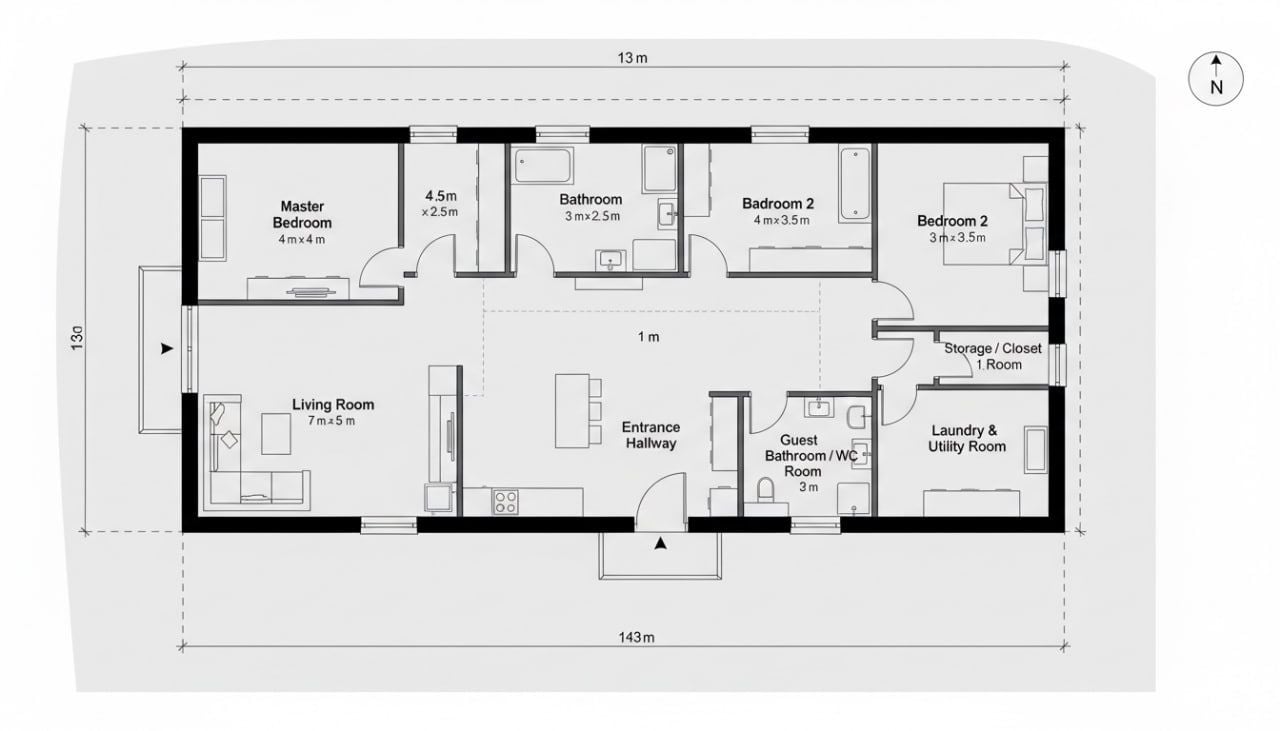
8. SPATIAL LOGIC: The Architectural Floor Plan Challenge
This prompt serves as a rigorous examination of Nano Banana Pro’s ability to interpret and visually execute complex spatial, dimensional, and relational data - the core of architectural design. It requires the model to function as a CAD (Computer-Aided Design) engine, not only as an image generator.
Prompt: "One-Floor House Architectural Plan (with room dimensions & layout)
Overall Structure Shape: rectangular,modern design
Approximate total area: 13m×11m=143m²
Entrance located on the south side,leading into the hallway
Floor Plan Layout (with exact sizes and locations)
1. Entrance Hallway Size:3m×2.5m Location: South side, center connects to living room and corridor
2. Living Room+Kitchen (Open Plan) Size: 7m×5m Location: South-west corner Features: large windows facing west,sliding door to backyard on the north wall Kitchen zone occupies the east part of the room
3. Master Bedroom Size: 4.5m×4m Location: North-west corner Contains a window facing north and west
4. Bedroom2 Size: 4m×3.5m Location: North-east corner Window facing east
5. Bedroom3/Office Size: 3.5m×3.5m Location: Center-east Window facing east
6. Bathroom Size: 3m×2.5m Location:Center-north Between Master Bedroom and Bedroom2
7. Guest Bathroom/WC Size: 2m×1.8m Location: South-east corner Accessible from hallway
8. Laundry&Utility Room Size: 3m×2m Location: Center-south,next to hallway Small door to the backyard on the east
9. Storage/Closet Room Size: 2m×1.5m Location: Between Bedroom3 and the hall corridor Adjacent to guest bathroom."
The Breakdown (The Dimensional Failure): Previous models could render a generic floor plan but failed catastrophically when asked to adhere to numeric dimensions. They could not execute simultaneous geometric constraints (e.g., ensuring Room 2 is exactly $7\text{m} \times 5\text{m}$) while maintaining the correct internal adjacency (e.g., ensuring Room 8 is correctly located "next to the hallway" with a backyard door).
Nano Banana Pro's Logic Gate: This prompt activates a dedicated Spatial Reasoning Engine that enforces four simultaneous constraints:
Enumeration & Dimensionality: Accurately generates the required nine rooms, with each element respecting its designated $X \times Y$ dimensions (e.g., $\mathbf{4.5\mathbf{m} \times 4\mathbf{m}}$ for the Master Bedroom).
Global Constraint Check: Verifies that the sum of the rooms, including necessary interior wall thicknesses and hallways, logically fits within the overall $\mathbf{13\mathbf{m} \times 11\mathbf{m}}$ outer structure.
Relational Adjacency: Correctly positions the rooms based on their connections and relative locations (e.g., placing the Bathroom in the center-north, precisely between the two bedrooms).
Diagrammatic Fidelity: Renders the output in the requested Architectural Plan style, including necessary features like door swings, window representations, and clean dimension lines, proving it can generate a functional technical diagram.
The Result: The successful generation of this prompt confirms Nano Banana Pro’s capability to serve as a powerful tool for architectural visualization and schematic development, turning complex dimensional text data into programmatically accurate diagrams.
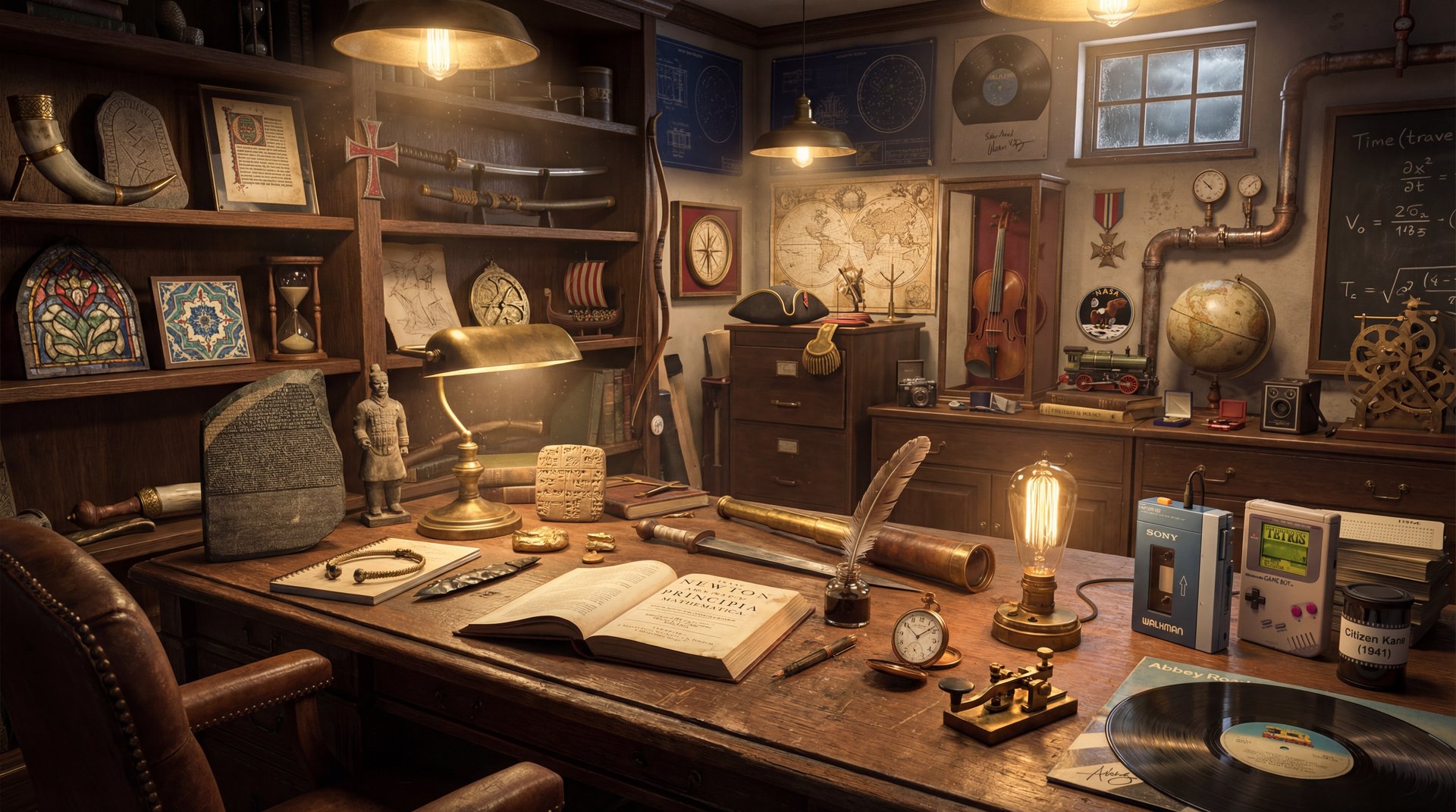
9. THE ULTIMATE TEST: The "50 Artifact Time-Traveler's Study"
This prompt is the acid test for Nano Banana Pro, demanding an unprecedented level of enumerative accuracy, specific object generation, contextual placement, and historical fidelity within a richly detailed environment.
Prompt: "Create an ultra-realistic, richly textured image of an eccentric time-traveler’s private study, filled with 50 real historical artifacts, displayed in perfect clarity. The room is dimly lit with warm tungsten lamps, soft shadows, dust floating in the air, wooden furniture, brass mechanisms, and worn leather textures. A large panoramic desk occupies the center, surrounded by shelves, crates, cabinets, glass domes, and wall mounts. Every item below must be clearly visible, physically placed, never floating, arranged naturally on shelves, the desk, the floor, or inside cases.
ANCIENT WORLD (1–12)
1. Rosetta Stone replica – with readable hieroglyphs and Greek text
2. Roman gladius sword – iron blade, bronze hilt
3. Athenian owl coin (Tetradrachm) – silver, worn edges
4. Egyptian Ankh amulet – carved stone
5. Terracotta Warrior miniature – Qin Dynasty replica
6. Babylonian cuneiform tablet
7. Greek Corinthian helmet – aged bronze patina
8. Scroll of the Epic of Gilgamesh – rolled parchment
9. Persian Darius I gold daric coin
10. Ancient Indus Valley seal – steatite block
11. Mayan obsidian blade
12. Celtic torc necklace – twisted gold
MEDIEVAL & RENAISSANCE (13–24)
13. Viking drinking horn – carved rim
14. Runestone fragment – Scandinavian rune carvings
15. Medieval illuminated manuscript page – gold leaf accents
16. Knights Templar cross pendant
17. Samurai katana (Muromachi period style)
18. Mongol recurve bow – wooden
19. Gothic church stained glass fragment
20. Leonardo da Vinci sketch sheet (from Vitruvian Man)
21. Renaissance astrolabe – brass with engraved numerals
22. Ottoman ceramic İznik tile – blue floral pattern
23. Medieval hourglass – sand half-fallen
24. Ancient Norse longship wooden model
AGE OF DISCOVERY / EARLY MODERN (25–34)
25. Isaac Newton’s “Principia Mathematica” – open page, readable Latin
26. Galileo-style brass telescope
27. Columbus-era navigation compass
28. Old world map by Gerardus Mercator
29. 18th-century quill & ink bottle
30. French Revolution tricorne hat
31. Benjamin Franklin’s lightning rod prototype (miniature)
32. Old pocket watch (1810s)
33. Napoleonic officer epaulettes
34. Worn violin (Stradivarius-style) displayed under glass
19TH–20TH CENTURY (35–46)
35. Steam engine miniature (Watt design)
36. Telegraph key – brass, functional design
37. Thomas Edison-style light bulb – glowing filament
38. Vintage Kodak Brownie camera
39. WWI military medal
40. Old globe (1910) – faded continents
41. NASA Apollo mission patch (Apollo 11)
42. USSR “Sputnik 1” model
43. First edition “Sherlock Holmes” book – readable spine
44. Victorian brass monocle
45. 1920s Art Deco cigarette case (empty)
46. Early IBM punch card stack
MODERN ODDITIES & CULTURAL ICONS (47–50)
47. Sony Walkman TPS-L2 – blue, iconic design
48. Game Boy (1989) – grey, with Tetris title visible
49. Film reel canister labeled “Citizen Kane (1941)”
50. Signed vinyl record of “The Beatles – Abbey Road”
ENVIRONMENT: THE TIME-TRAVELER’S ROOM
The room itself is a character:
• A massive oak desk with scratches, ink stains, engraved initials
• Brass desk lamp with warm light illuminating artifacts
• Dark wooden bookshelves stacked with atlases and notebooks
• Polished concrete floor with scattered papers
• A vintage leather chair, cracked and worn
• Glass domes protecting fragile relics
• Blueprints, diagrams, star charts pinned to walls
• A chalkboard with equations, timelines, wormhole sketches
• A mechanical clockwork contraption, partly disassembled
• Steam pipes and pressure gauges along one wall
• A small window showing stormy weather outside
Everything must look tactile: wood grain, metal oxidation, parchment fibers, scratches, dust motes in the light."